

By Thato Ramogase, Executive Associate at Change Logic
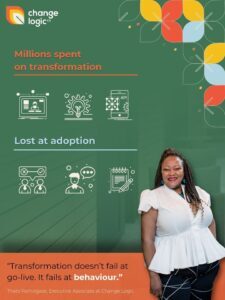 South African organisations are not short on ambition when it comes to transformation. Across industries, businesses are investing in ERP modernisation, digital platforms, automation, and new operating models to stay competitive in a rapidly evolving market. On paper, these programmes are sound. In practice, many are falling short of their intended value.
This gap is not caused by poor technology choices or flawed strategy. It is driven by something far less visible, and far more critical. Organisations are scaling transformation faster than they are building the internal capability required to absorb it.
Research continues to reinforce this reality. Local studies, including findings published in the South African Journal of Industrial Psychology, show that employees do not experience change as a simple process update. It is something they process cognitively, emotionally, and physically. That human response is often underestimated, and it is precisely where many transformation efforts begin to lose momentum.
Globally, the pattern is consistent. Bain & Company has reported that nearly nine out of ten transformation programmes fail to achieve their original ambitions. The issue is not isolated. It is systemic.
Transformation fatigue is no longer a soft issue
Organisations are not running a single transformation programme at a time. They are running several. ERP upgrades sit alongside digital customer initiatives, operational redesign, cost optimisation, and regulatory programmes. Each initiative is justified. Together, they create a constant state of change.
This is where transformation fatigue begins to take shape. Gartner’s research highlights a critical shift. Employees are experiencing significantly more enterprise change than ever before, while their willingness to support it is declining. Expectations around performance remain high, yet the environment they are operating in is continuously shifting. Over time, this creates pressure that is not always visible in dashboards or programme reports.
Employees may understand the need for change, but translating new systems and strategies into daily behaviour becomes increasingly difficult. Middle management carries the weight of this tension, balancing strategic intent with operational reality. As programmes continue to roll out, enthusiasm is often replaced by scepticism. What organisations experience is not outright resistance. It is something more subtle, and far more dangerous.
Disengagement.
Technology programmes rarely fail for technical reasons
One of the most persistent misconceptions in transformation is that risk sits primarily in technology delivery. In reality, the highest risk emerges after go live. ERP implementations illustrate this clearly. Significant effort goes into platform selection, system configuration and technical delivery. Yet the real test begins when employees are expected to adopt new processes, decision frameworks and ways of working. When this transition is not effectively managed, organisations do what they need to in order to keep operating. Manual processes reappear alongside digital systems. Teams develop workarounds. Policies are adjusted to maintain continuity. Employees revert to familiar behaviours under pressure. These responses are not irrational. They are practical. But they come at a cost. They prevent organisations from realising the value of the transformation they invested in.
The capability gap organisations are not addressing
Most organisations understand that change is necessary. That is not the issue. The gap lies in how change is managed. In many businesses, change management is still treated as a project activity. Teams are assembled for a specific initiative and disbanded once it is complete. Each new programme effectively starts again from zero. This approach worked when transformation was occasional. It does not work when transformation is continuous. From what we see across South African organisations, the businesses that are succeeding are treating change differently. They are not embedding it within projects. They are building it as an organisational capability. This includes structured approaches to leadership alignment, employee engagement, readiness assessment and behavioural adoption. More importantly, it creates consistency in how change is managed across the business. It shifts change from being reactive to being deliberate.
The ownership question is still unresolved
Another signal of this capability gap is the ongoing debate around ownership.
Should change sit within HR?
Should it be driven by transformation offices?
Should it sit under strategy or operations?
Each of these functions plays a role, but none of them, on their own, fully address the complexity of change. Effective change capability cuts across leadership, strategy, operations and people. When it is owned by a single function, it is often constrained by that function’s priorities and perspective. The organisations that are navigating transformation successfully are starting to recognise this. There is growing interest in establishing internal Change Management Offices, not as governance layers, but as permanent capabilities. The objective is consistency. The ability to manage change across multiple initiatives without starting from scratch each time.
Why this matters more in South Africa
South African organisations operate in a uniquely complex environment. Economic pressure, regulatory demands and global competition require businesses to adapt continuously. Transformation is not optional. It is fundamental to survival. As organisations continue to modernise systems, adopt new technologies and rethink operating models, the volume of change will only increase. The differentiator will not be who invests the most in technology. It will be who builds the capability to make that change stick. Technology can be bought. Strategy can be designed. But the ability to implement change consistently, at scale and over time is something that has to be built from within.
The question organisations should be asking
As we look ahead, the conversation needs to shift. The question is no longer whether organisations are transforming. Most already are. The real question is whether they are building the internal capability required to make that transformation work. Because without that capability, even the best strategies will struggle to deliver their intended value. And that is where the real transformation challenge lies.
Our team is ready to support your transformation programmes – reach out to us!
___________________________________________________________________________________________________________________________________
Frequently Asked Questions
What is change capability in an organisation?
Change capability refers to an organisation’s ability to consistently translate strategy, systems and new ways of working into sustained behaviour and performance. It is not a once-off project activity. It is a structured, repeatable discipline that enables businesses to absorb and execute change at scale.
Why do transformation programmes fail even when the technology works?
Most transformation programmes fail after go-live, not during implementation. While systems may be technically sound, employees often revert to familiar ways of working, create workarounds or disengage if adoption is not actively managed. The failure is typically behavioural, not technical.
What is transformation fatigue and why does it matter?
Transformation fatigue occurs when employees are exposed to continuous, overlapping change initiatives without sufficient support or capacity to adapt. Over time, this leads to disengagement, reduced productivity and declining support for new programmes, directly impacting business outcomes.
Where should change management sit in an organisation?
There is no single function that can fully own change. While HR, strategy and transformation offices all play a role, effective change capability cuts across the organisation. Leading organisations are moving towards establishing centralised change capability functions that enable consistency across programmes.
What is a Change Management Office?
A Change Management Office is a central capability that provides structure, governance and consistency for how change is managed across an organisation. Unlike project-based teams, it is a permanent function focused on building long-term change capability rather than supporting individual initiatives in isolation.
How can organisations improve adoption of new systems and processes?
Improving adoption requires more than communication and training. It involves understanding behavioural drivers, building readiness at role level, aligning leadership, and continuously measuring and responding to adoption signals throughout the transformation lifecycle.
Why is change capability especially important in South Africa?
South African organisations operate in complex and often volatile environments. Economic pressure, regulatory requirements and global competition demand constant adaptation. Without strong change capability, organisations struggle to keep pace with the scale and speed of transformation required to remain competitive.